what would cause you to see spider web s when looking at head lights
Spider mites, likewise referred to as web-spinning mites, infest home and agricultural areas around the world. They spin their webs on the stems and the underside of the leaves where they also lay dozens of eggs. This webbing makes it easy to identify an infestation and distinguish web-spinning mites from different mite species and other plant-damaging pests such as aphids.
How to Identify Spider Mites

Image of a Red Spider Mite on a leaf.
You might not see spider mites at first glance; however, if you look closer, you'll notice tiny dots moving frantically over the leaf'southward surface. Gazing through a magnifying glass reveals an entirely different moving picture and gives you a close-up look of these invasive pests at work. Numerous spider mite species live and thrive in backyard gardens and in greenhouses, and y'all can place many of them past examining their body type, color and markings. Some of the well-nigh mutual spider mites include:
- Two-spotted spider mites: These mites were once only native to Europe and Asia, but they take spread across the globe in shipping containers. They range in color from dark red to green, which makes them fifty-fifty more difficult to see against the leaves. Nether magnification, you tin see 2 dark spots along their backs. Ii-spotted spider mites have pocket-sized, oval-shaped bodies and feast on everything from vegetables to flowers.
- Southern cherry mites: Blood-red mites take a cherry-red appearance and bulbous-shaped bodies. They mostly attack broadleaf plants and often invade shrubs and herb gardens. Crimson mites non only feast on the jail cell content within leaves but besides on the fruit itself, creating even more havoc in agricultural crops. They thrive in absurd conditions during the spring and the fall and normally go dormant in the summer.
- Spruce mites: These mites feed on needle-leaved conifers and cause massive damage in tree farms. Every bit hatchlings, they appear lighter green in color and turn darker equally they mature. Bandbox mites besides adopt cooler weather and lay their eggs at the base of the needles to survive the wintertime.
Other common spider mites include the European spider mite and the citrus mite. Regardless of the species, each of these mites threaten plants wherever they go. In small numbers, they cause insignificant damage to plants. However, these tiny arachnids can destroy entire crops and greenhouse plants without conscientious management and command.
The Spider Mite Life Cycle
Depending on the location, some spider mites tin can feed and reproduce throughout the entire year as long as the plants retain their leaves. In cooler areas where trees and plants drib their leaves, spider mites spend the winter under the bark or in ground litter. They render to feeding and reproducing once the weather permits and the leaves grow light-green and strong.
Spider mite development varies depending on the species, just each mite goes through like life cycles. This bicycle includes the egg, the larvae, 2 nymph stages and the final developed phase, and the unabridged development cycle tin can take anywhere from v to 20 days nether ideal conditions. Female person spider mites alive between two and four weeks and can lay several hundred eggs during their lifetime.
The eggs, which are translucent and take a spherical shape, look like tiny h2o aerosol confronting the leaves. As the spider mites develop inside the casing, the eggs transition from being translucent to having a cream colour. The hatchlings and so break out from the eggs and have only six legs; all the same, they develop all eight legs as they mature. The young feed on the underside of the leaves and go along to impairment the plant as they develop into adults.
Spider Mites and the Damage They Cause
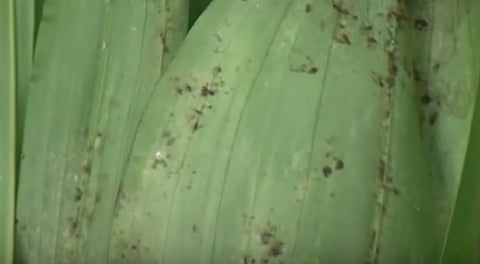
Astringent spider mite damage to leaves.
Spider mites, dissimilar their larger arachnid cousins, don't have fangs for bitter into their prey. Instead, they take piercing mouthparts that penetrate the leaves and suck out the sap. A few spider mites take minimal affect on a plant, but larger populations tin showtime to show visible damage to the leaves and kill the entire constitute without proper control.
The first sign of spider mite damage appears as minor, lightly colored dots along the leaves. After a while, vibrant leaves may fade in color and appear to have a bronze sheen. As the spider mite population grows and continues to feed on the plant, the leaves will turn yellowish or scarlet and fall to the ground. By this time, you can easily place a spider mite infestation as the webbing covers much of the leaves and the stems.
You'll probably notice leafage and stem impairment long before you e'er see whatsoever spider mites, so audit your plants regularly to forbid a few spider mites from evolving into a devastating population. To identify a possible spider mite infestation, yous should:
- Quarantine any plant that may take spider mites.
- Examine the underside of the leaves for webbing.
- Audit the unabridged found with a magnifying glass.
- Check the leaves for minor dots and yellow markings.
Spider mites target everything from ornamental potted plants to agricultural crops. Vegetable crops and fruit copse endure massive leaf loss, which causes sunburning and reduces yield for the harvest. On ornamentals, spider mites ruin the plants' aesthetic appeal and can likewise kill the plants if the infestation grows out of control.
Decision-making and Managing Spider Mite Infestations
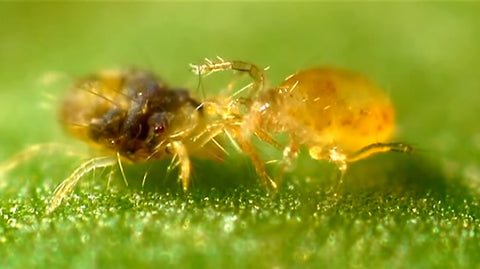
A predatory mite (Anderline aa) preying on a constitute-damaging mite.
Thankfully, spider mites have many natural enemies that help reduce infestations and limit population overgrowth. Some of these natural predators include:
- Phytoline P (Phytoseiulus Persimilis)
- Amblyline cu CRS (Predatory Mite)
- Anderline aa (Predatory Mite)
- Exhibitline sf ( Predatory Thrips)
In many cases, the predators take care of entire infestations without the need for human intervention. Due to chemical spraying and the loss of beneficial insects, spider mites may have less predators to worry about in the surface area. However, the mites may besides run rampant in greenhouses and interiorscapes where workers prefer not to employ chemical pesticides. These areas accept less natural predators, providing a safer convenance ground for mites to grow in numbers.
Even with chemic treatment, not all pesticides work to kill spider mites. Still, some pesticides accept special formulas that not only eradicate spider mites but do then without harming the plant in whatsoever way. Whether you choose biological control or chemical miticides depends on the treatment surface area and the severity of the problem.
Monitoring the Target Area
Yous should e'er check for mites before you utilise whatsoever handling to an area. Sometimes, y'all may notice leaf damage after the mites take already left the constitute, so treating the plant may only cause more than impairment depending on which treatment method you lot use. Because spider mites are difficult to detect, use a handheld magnifying glass to observe the leaves more closely. You lot can also hold a canvas of white notebook paper under the leaves as you lot milk shake the establish. The mites should autumn off the leaves and onto the newspaper where yous can see them more clearly.
Later on you've detected a spider mite infestation, the next step involves choosing a handling option for eliminating the threat. You have three primary handling options to choose from: biological control, chemical control and cultural control. Each method has its ain advantages and disadvantages, and you lot may have to combine different methods to become a more than constructive result.
Choosing Biological Command for Eliminating Spider Mites
When spider mites take taken over gardens, crops and ornamentals, introducing natural predators into the area can have a profound effect. Natural enemies such every bit Galendromus occidentalis, a predatory mite, hunts and feeds on web-spinning mites. These predatory mites are about the aforementioned size every bit spider mites only have longer legs and teardrop-shaped bodies. They run very quickly and go on to feed on spider mites until they've vanished from the found.
Predatory mites don't feed on plants or become pests themselves. In fact, if they have no nutrient source available in the surface area, they either starve and die or move elsewhere in search of casualty. Y'all can purchase predatory mites and other natural spider mite enemies as adults and release them directly on the target plants. It only takes one predator mite for every x spider mites to reduce population numbers. Once the predator mites have established on perennials, they may reproduce and provide residue control.
Using Chemical Command to Combat Spider Mite Infestations
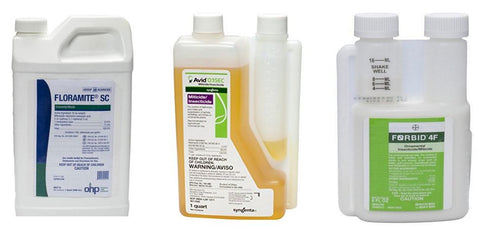
Floramite SC, Avid 0.15EC and Forbid 4F for killing spider mites.
Applying chemic insecticides in the target area comes with risks. Later on all, if insecticides kill beneficial mite predators, you're essentially making things worse. Carbaryl, a mutual chemical in pesticides, appears to affect spider mites in a positive way. In field studies, the carbaryl actually helped the spider mites to reproduce faster than mites that were left untreated. In improver, applying the insecticide during hot weather acquired severe mite outbreaks within days.
Because mites don't belong in the same category every bit insects, they require a different course of treatment. Miticides, such equally Gorging 0.xv and Floramite SC, target invasive mites while minimizing the impact on surrounding insects. These miticides work to command spider mites of all types, from the two-spotted spider mite to the clover mite. Miticides similar Floramite SC help to eliminate spider mites in:
- Greenhouses
- Establish nurseries
- Conifer plantations
- Interiorscapes
- Landscapes
- Public, commercial and industrial areas
- Golf courses, parks and other recreational sites
Relying on Cultural Control for Spider Mites
Dry, dusty conditions can lead to spider mite infestations in agronomical crops and throughout landscapes. To assist minimize an outbreak, apply water to dusty areas and pathways regularly. Spraying copse and plants with water slows the mites' progress and the damage they cause. You should also provide sufficient irrigation to wash away the mites as they build upwardly on the plants.
Forcefully spraying water on plants in domicile gardens also helps to reduce spider mite numbers peculiarly if you lot provide thorough coverage on and below the leaves. For added control, combine the h2o with insecticidal soap or oil to eradicate fifty-fifty more mites on the plants. However, exam the soaps and oils on one or more plants first to see how they react to the treatment.
Preventing Spider Mite Infestations on Leaf
Performing preventative maintenance in the garden and on copse and shrubs can assistance eliminate spider mite infestations earlier they occur. Water the target area at acceptable intervals, and use natural soaps and oils to limit populations without harming other insects. Avoid broad-spectrum pesticides that impale benign predators, and introduce natural predators like ladybugs to the area when y'all can. Existence mindful of spider mites and taking preventative measures beforehand tin help y'all avoid a serious mite outbreak and go along your plants prophylactic, healthy and vibrant.
In writing this piece the cognition and insight was gained through learning journey. The thoughts expressed here was learned through all-encompassing reading and research. I was truly amazed at the amount of information that is available. A person could spend hours looking and learning on www.uvm.edu/%7Eentlab/Greenhouse%20IPM/UVMGreenhouseIPM.html The information compiled by Ms. Frank Sullivan and Skinner is both interesting and informative. Yous practise not have to have a dictionary next to you to understand the information that is being presented and it does not put you to sleep. The UC IPM site past UC Davis world wide web.ipm.ucdavis.edu/index.html is also a treasure trove of information and guidance. This is some other public website that I am happy to say is revenue enhancement payer money well spent along with the Cornell Garden-Based Learning resources available at http://gardening.cce.cornell.edu I expect frontwards to hearing your thoughts on this subject.
Source: https://www.pedchem.com/blogs/news-articles/17825332-spider-mites-a-beginner-guide-to-understanding-and-controlling-mites

Post a Comment for "what would cause you to see spider web s when looking at head lights"